
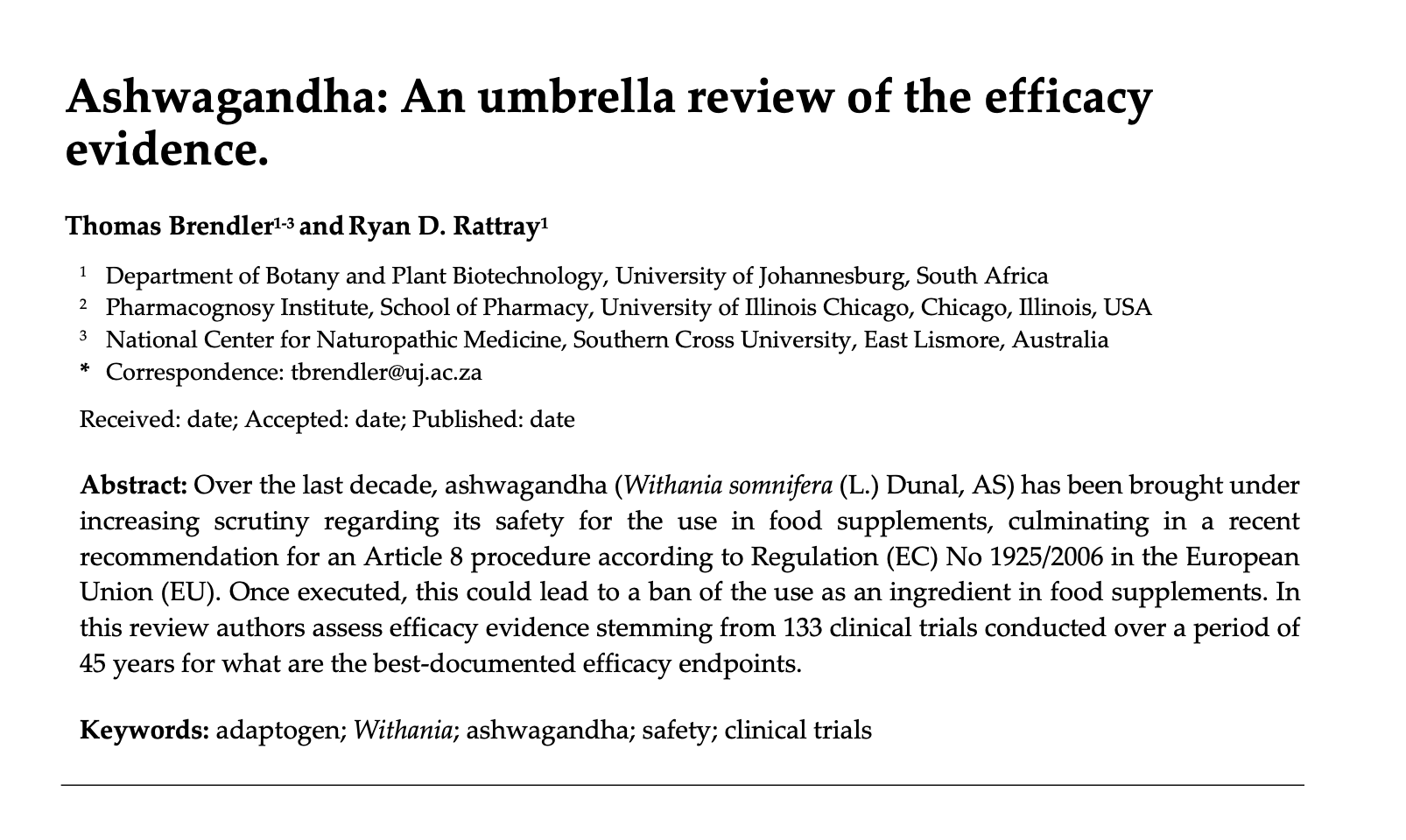
Ashwagandha: An Umbrella Review of the Efficacy Evidence by Brendler and Rattray (preprint, 2026) provides a comprehensive evaluation of the human clinical evidence for Withania somnifera across the principal efficacy domains associated with its traditional and contemporary use.
The authors identified 134 clinical trial reports published over approximately 45 years, of which 133 were included in the assessment. Rather than limiting the review to existing meta-analyses or systematic reviews, the authors attempted to map the available clinical trial literature directly and organize it by major outcome categories. These included stress, anxiety, mood, sleep, energy, endurance, musculoskeletal outcomes, reproductive and sexual health, cognition, safety, tolerability, pharmacokinetics, metabolic endpoints, inflammatory conditions, pediatric outcomes, and adjunctive oncology-related research.
The review is framed against the background of increasing regulatory scrutiny of ashwagandha, particularly in the European Union, where concerns regarding safety in food supplements have contributed to discussion of a possible Article 8 procedure under Regulation (EC) No. 1925/2006. The authors therefore examine not only whether clinical trials report efficacy, but also how the breadth and quality of the human evidence base should be interpreted in relation to contemporary risk assessment.
The most extensively studied clinical domains are stress, anxiety, mood, sleep, cognition, physical performance, and reproductive health. In stress and anxiety studies, multiple randomized, double-blind, placebo-controlled trials reported improvements in validated psychometric measures, including perceived stress, anxiety scales, mood indices, and quality-of-life measures. Several studies also reported reductions in cortisol, supporting the interpretation that ashwagandha may exert effects through modulation of stress-response physiology. Products studied in this domain included KSM-66, Shoden, Sensoril/Essentra, Shagandha, Prolanza/AshwaSR, Zenroot, PE-series extracts, and root powder preparations.
Evidence for effects on energy, endurance, and musculoskeletal outcomes was also substantial. Trials reported improvements in measures such as VO₂ max, resistance-training adaptations, muscle strength, recovery scores, fatigue indices, walking distance, and quality-of-life outcomes. However, the magnitude and consistency of these effects varied by product, study population, training context, trial duration, and endpoint selection. Some trials reported statistically significant improvements, while others found no meaningful effect beyond training or placebo-associated changes. This pattern indicates a potentially meaningful but product- and context-dependent evidence base rather than a uniform class effect.
The review also summarizes a considerable number of trials involving reproductive and sexual health outcomes. In men, studies evaluated semen parameters, sperm concentration and motility, testosterone, luteinizing hormone, sexual desire, erectile function, and fertility-related endpoints.
Several studies reported improvements in sperm parameters and increases in testosterone or luteinizing hormone. In women, studies evaluated sexual function, sexual distress, menopausal symptoms, estradiol, follicle-stimulating hormone, luteinizing hormone, and quality-of-life measures. Some trials reported improvements in female sexual function and menopausal symptom scores, and several reported changes in reproductive hormones. These findings suggest that ashwagandha may have measurable effects on reproductive or endocrine physiology in some populations, although interpretation requires attention to baseline health status, dose, extract type, and study design.
The clinical evidence base is unevenly distributed across product types. Root powder preparations represent a large portion of the evidence base, particularly in reproductive health, endurance, and traditional-use-related endpoints.
A notable feature of the review is that the clinical evidence is not confined to root-only preparations.
While root extracts and root powders constitute a large share of the trial literature, root-and-leaf preparations are also represented. Sensoril and Shoden, for example, appears across multiple clinical domains, including stress, mood, cognition, hemodynamic stress response, menopause-related outcomes, osteoarthritis, and joint pain.
The presence of root-and-leaf preparations in human clinical trials is relevant to plant-part safety discussions because it shows that leaf-containing preparations have been studied clinically, rather than existing only as untested exposures.
Sensoril/Essentra and Shoden are examples of preparations containing both root and leaf, both studied for stress, mood, cognition, menopause, joint pain, and related outcomes. Other extracts and preparations contribute smaller but sometimes focused datasets. This distribution is important because clinical findings for one extract cannot automatically be generalized to all ashwagandha preparations, unless the preparations are chemically and pharmacologically comparable.
The safety, tolerability, and pharmacokinetic data summarized in the review include dedicated studies of root extracts and other standardized preparations. Pharmacokinetic and tolerability studies involving Shoden, Prolanza, Zenroot, KSM-66, LongeFera, Witholytin/AgeVel, and other preparations provided evidence of systemic withanolide exposure from root and leaf, and generally favorable tolerability in the studied populations.
For more information on clinical trials on ashwagandha, contact us.