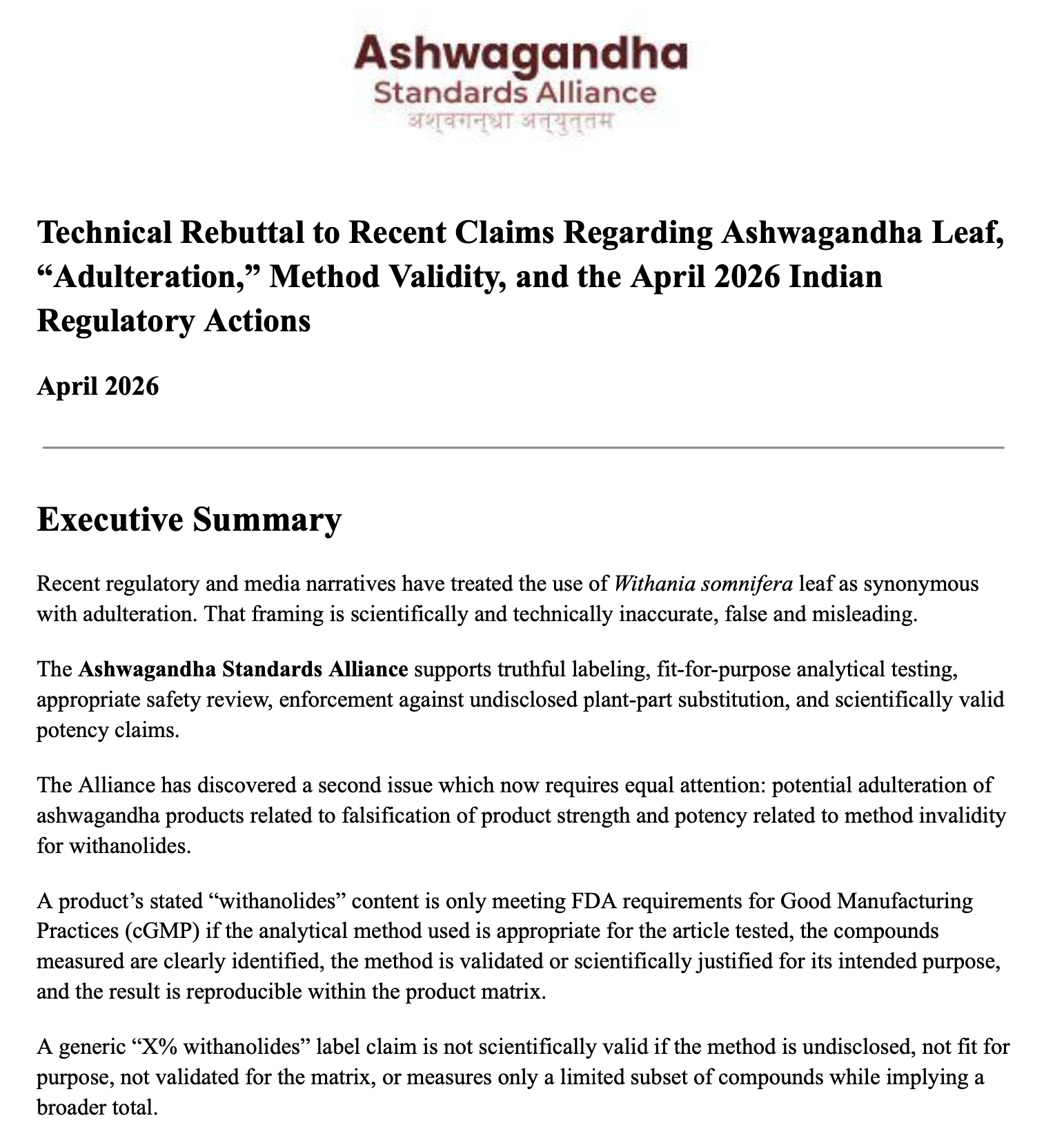
Technical Rebuttal to Recent Claims Regarding Ashwagandha Leaf, “Adulteration,” Method Validity, and the April 2026 Indian Regulatory Actions is a technical position report addressing recent regulatory and media claims that equate Withania somnifera leaf use with adulteration. The report argues that this framing is scientifically overbroad and technically imprecise. It distinguishes between undisclosed plant-part substitution, disclosed use of leaf or root-and-leaf material, and unsupported potency claims based on inadequately disclosed or non-fit-for-purpose analytical methods.
The central thesis is that “adulteration” should not be used as a categorical descriptor for all ashwagandha products containing leaf material. If a product is represented as ashwagandha root or root extract but contains undeclared leaf or aerial parts, that may constitute adulteration, misbranding, or failure to meet specification, depending on the relevant jurisdiction and claim. However, if a product is accurately described as containing leaf, aerial parts, or root-and-leaf material, the appropriate evaluation is not categorical condemnation but a technical assessment of identity, composition, specifications, safety data, exposure, labeling, and regulatory category.
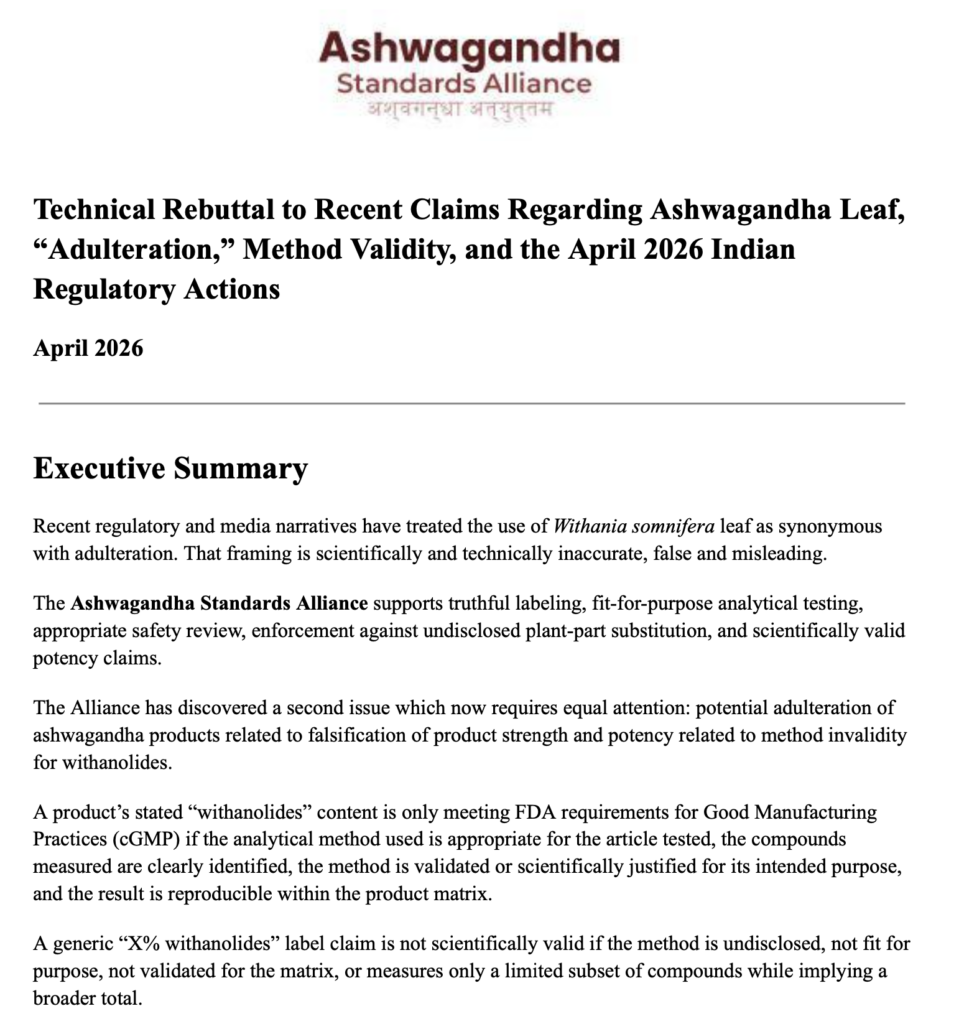
The report also identifies a second and independent quality concern: the validity of “withanolides” potency claims. It argues that a generic percentage claim, such as “5% withanolides,” is not scientifically meaningful unless the analytical method is disclosed or otherwise sufficiently characterized, the compounds measured are clearly identified, the method is fit for the matrix tested, and the result is reproducible. A certificate of analysis reporting a potency value does not itself establish that the claim is valid. The analytical method must support the specific claim being made.
A major technical contribution of the report is its separation of three issues often conflated in public discussion: first, undisclosed substitution of leaf for root; second, disclosed and characterized use of leaf, aerial parts, or root-and-leaf material; and third, potency claims made without valid analytical support. The report emphasizes that these are distinct compliance and scientific questions. Undisclosed substitution concerns identity and labeling. Disclosed plant-part use concerns safety, exposure, specification, and jurisdictional status. Unsupported potency claims concern method validity, GMP compliance, label substantiation, and reproducibility.
The report critiques the April 2026 Indian regulatory actions by the Ministry of Ayush and FSSAI as establishing or reiterating a root-only position for certain Indian regulatory categories, including Ayush products and Indian food products. It argues that these actions should not be automatically interpreted as a global scientific finding that leaf-containing ashwagandha products are unsafe, adulterated, or unlawful in other jurisdictions. The report stresses that Indian regulatory decisions may affect supply and compliance in India and related markets, but should not be generalized beyond their legal and evidentiary scope without independent scientific review.
The report gives particular attention to the role of analytical method validity in ashwagandha quality control. It notes that different methods may measure different compounds or compound classes, including selected withanolide aglycones, withanolide glycosides, withaferin A, calculated equivalents, hydrolyzed totals, or chromatographic fingerprints. Therefore, “total withanolides” is method-dependent and may be incomplete or misleading unless the analytes, method, matrix, validation status, and intended analytical purpose are disclosed.
The document proposes a technical framework for ashwagandha quality assessment. This framework includes botanical identity, plant-part confirmation, marker-compound quantification, chromatographic fingerprinting, detection of undeclared substitution, fit-for-purpose potency testing, safety-relevant constituent limits, batch-to-batch consistency, finished-product verification, and label-claim substantiation. These elements are presented as necessary to distinguish legitimate quality concerns from commercially convenient or scientifically unsupported narratives.
The report also challenges the assumption that tradition alone determines safety or legality. It acknowledges the long historical use of ashwagandha root in Ayurveda but argues that modern commercial extracts must be evaluated by composition, dose, exposure, manufacturing process, marker profile, contaminant profile, analytical method validity, and clinical or toxicological data. Conversely, it argues that a less traditional plant part is not automatically unsafe merely because its historical use differs from root. Safety must be evaluated by the actual article of commerce and its intended conditions of use.
The report’s discussion of public and trade-media framing is also significant. It argues that sponsored or commercially interested narratives have blurred the distinction between regulatory action, scientific consensus, promotional claims, and independent technical analysis. The document does not reject regulation or enforcement. Rather, it calls for transparency regarding the evidence used by regulators, expert-committee composition, conflicts of interest, stakeholder submissions, analytical methods cited in public claims, and the rationale for treating leaf use as a categorical prohibition rather than a composition- and exposure-specific safety question.
The report concludes that ashwagandha quality standards should not be reduced to a simple “root good, leaf bad” framework. A scientifically defensible approach should evaluate whether the species is correctly identified, the plant part is truthfully labeled, the extract is fully characterized, potency claims are method-valid, safety data match the article of commerce, and claims are substantiated by relevant evidence. Under this approach, undisclosed substitution and unsupported potency claims are legitimate compliance concerns, while disclosed root-and-leaf use requires product-specific evaluation rather than categorical classification as adulteration.