
Author: ashwagandhastandards

  • Join the Alliance Now

    Join the Alliance Now

    Ashwagandha has become one of the most widely used botanical ingredients in global health and wellness.

    But growth has exposed some problems, and the public conversation has become misguided.

    Meanwhile, important questions are sometimes ignored. When we argue about plant part, the serious questions are missed:

    ❓ Was the product accurately labeled?

    ❓ Was the fingerprint representative of ashwagandha?

    ❓Were allergens and contaminants tested?

    ❓Were the test methods valid?

    ❓Was the product made under real GMP controls?

    ❓Did the ingredient actually match the material used in the safety or clinical study used to substantiate it?

    The answers to these questions are what paints the quality picture for ashwagandha — and any other botanical too.

    That is why the Ashwagandha Standards Alliance is opening membership to the broader global community of responsible ashwagandha stakeholders.

    We are not a marketing coalition or a trade group built to defend one commercial position.

    We are intended to be a globally credible, scientifically grounded, structurally independent alliance built around a simple principle: Ashwagandha deserves standards equal to its global use.

    Our goal is to create a unified voice in the marketplace for scientific standards, and to build a shared, credible, science-based platform to create a bright future for ashwagandha.

    ASA is being formed as a collaborative, science-anchored initiative dedicated to advancing the global integrity of ashwagandha through:

    • Evidence-based safety review
    • Analytical harmonization
    • Transparent quality practices
    • Responsible communication
    • Truthful labeling
    • Regulatory dialogue
    • Public education

    Our mission is simple:

    A credible voice for ashwagandha quality and science.

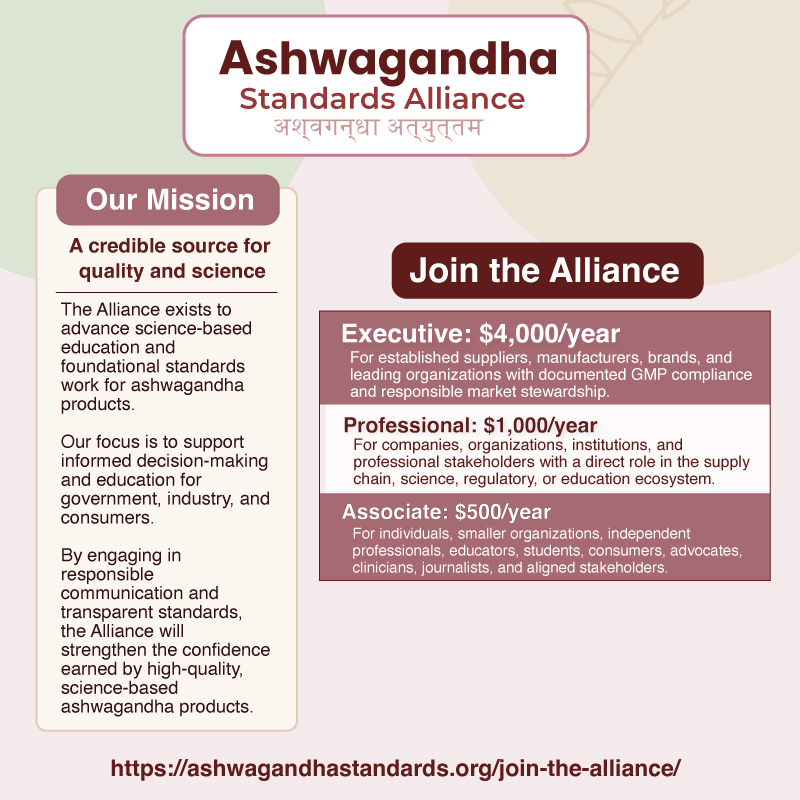
    The Alliance exists to advance science-based education and foundational standards work for ashwagandha products. Our focus is to support informed decision-making and education for government, industry, and consumers.

    By encouraging responsible communication and transparent quality standards, the Alliance helps strengthen the confidence in ashwagandha products that it has earned.

    Membership is open to suppliers, brands, manufacturers, laboratories, researchers, clinicians, trade organizations, educators, media professionals, and other stakeholders who believe ashwagandha deserves standards equal to its global use.

    Founding members will have opportunities to participate in technical discussions, working groups, education efforts, draft publications, stakeholder briefings, regulatory updates, and public communication initiatives.

    Because the future of ashwagandha should not be shaped by panic, selective science, hidden agendas, or sloppy testing.

    It should be shaped by people willing to do the work.

    Science.
    Quality.
    Transparency.
    Context.
    Trust.

    That’s the work ahead of us

    Join the Ashwagandha Standards Alliance today by completing the Membership Application below — or visiting https://ashwagandhastandards.org/join-the-alliance/
    Alliance Membership Application

    Full Name
  • Supplyside Supplement Journal: ASA sets sights on ashwagandha standards and education

    Supplyside Supplement Journal: ASA sets sights on ashwagandha standards and education

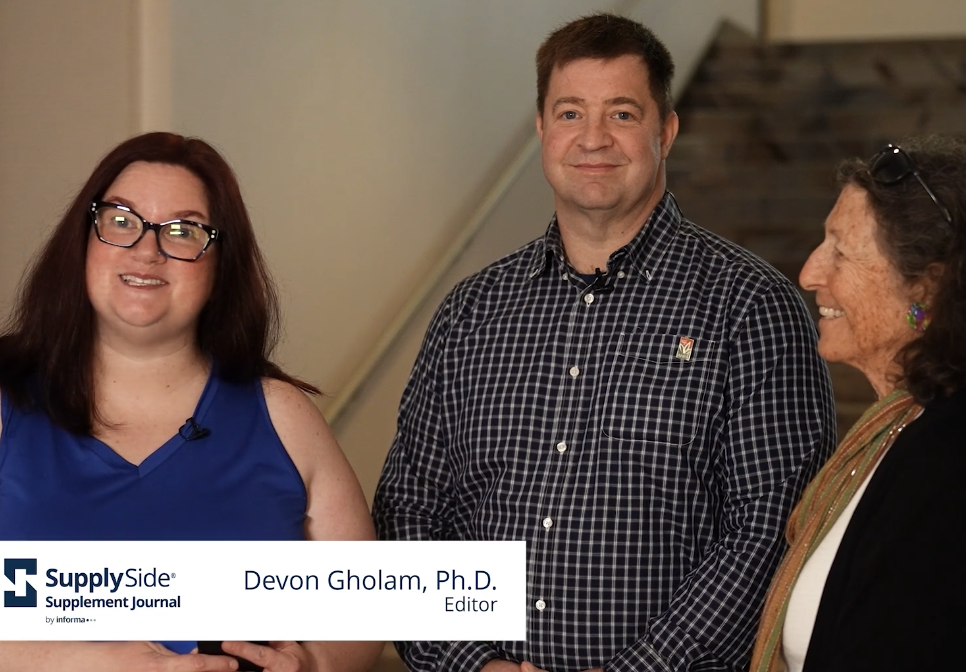
    Thank you to Devon Gholam, Ph.D. and SupplySide Supplement Journal for covering the Ashwagandha Standards Alliance.

    One line in the article captures the problem well:

    “The market and wide variety of available ingredients have led to consumer confusion around ashwagandha.”

    That’s the primary issue.

    Ashwagandha is no longer a small niche botanical. So when any ingredient gets as big as ashwagandha is now, we might expect the growing pains that we’re seeing now

    Different extracts, plant parts, standardizations, safety narratives and regulatory responses.

    Some of that complexity is real.

    But the answer shouldn’t be panic or marketing spin.

    The Alliance is focused on six priorities:

    Education.
    Safety.
    Quality.
    Analytical harmonization.
    Transparency.
    Public trust.

    As the article states, ASA was formed after stakeholders came together to try to clarify the confusion and address some of the challenges and issues around communication of the science.

    Let’s avoid the fear and the slogans, and focus on better standards, better methods, and better context.

    Read the article here:
    https://www.supplysidesj.com/business-resources/new-alliance-sets-sights-on-ashwagandha-standards

  • New Infographic: Ashwagandha Facts, Not Fear

    New Infographic: Ashwagandha Facts, Not Fear

    A Science-Based Guide to Safety, Quality and Labeling for Industry

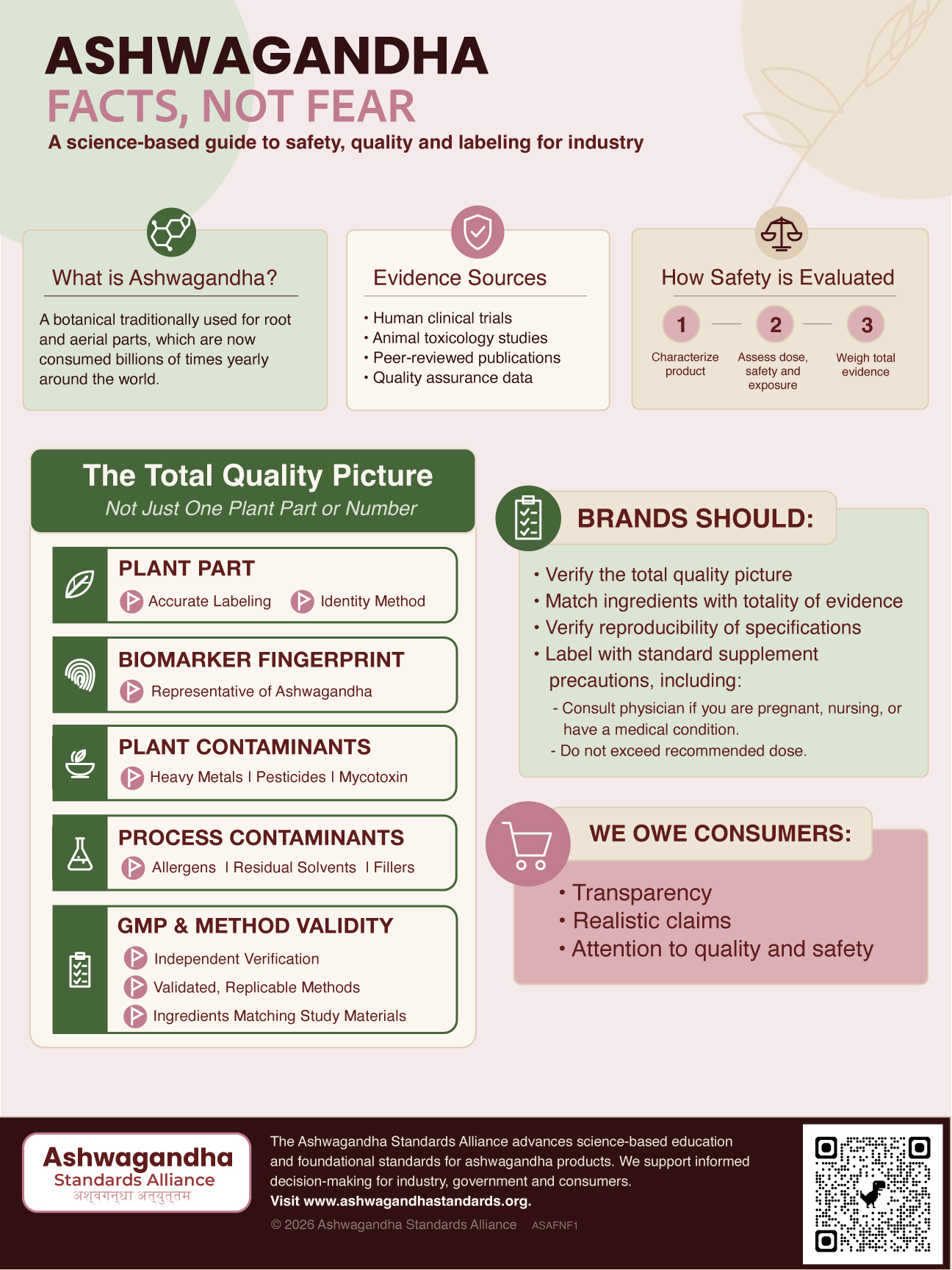
    The Ashwagandha Standards Alliance has released a new educational infographic, Ashwagandha Facts, Not Fear, to help brands, regulators, practitioners and consumers better understand how ashwagandha products should be evaluated.

    Ashwagandha is one of the most widely used botanicals in the world. It is also increasingly the subject of simplified narratives that do not reflect the full evidence base or the complexity of botanical quality.

    A quality ashwagandha product cannot be defined by a single plant part, a single constituent or a single number on a specification sheet.

    It must be evaluated as a complete product.

    Safety Requires the Totality of Evidence

    Safety evaluation begins by identifying what product is actually being used: the plant part, extract type, dose, biomarker fingerprint, manufacturing process and intended population.

    From there, safety assessment should consider:

    • Human clinical trials
    • Animal toxicology studies
    • Peer-reviewed publications
    • Quality assurance data
    • Dose and exposure
    • Product-specific composition

    This is how responsible evaluation works: characterize the product, assess the dose and exposure, and weigh the totality of evidence.

    Not by fear, marketing or treating all ashwagandha ingredients as interchangeable.

    Ashwagandha Facts Not Fear

    Quality Is More Than Plant Part

    Plant part matters. But plant part alone does not establish quality, safety or clinical relevance.

    A complete quality assessment should also address:

    • Biomarker fingerprint: Is the product chemically representative of the ashwagandha material it claims to contain? Which withanolides are identified on the HPLC chromatogram representing “total withanolides”?
    • Plant contaminants: Has the product been appropriately assessed for heavy metals, pesticides and mycotoxins?
    • Process contaminants: Have risks from allergens, residual solvents, fillers or other manufacturing-related issues been evaluated? Are they being truthfully labeled on ingredients and finished products?
    • Method validity: Are analytical methods validated, replicable and fit for purpose?
    • Independent verification: Can product specifications be reproduced and confirmed?
    • Evidence matching: Does the marketed ingredient actually match the material used in supporting studies?

    The answers to these questions determine whether brands can stand behind their products — and whether consumers can trust what is on the label.

    What Brands Should Do

    Brands selling ashwagandha products have a responsibility to move beyond simplified narratives and verify the total quality picture.

    That means they should:

    • Verify the identity, composition and quality of their ingredients.
    • Match ingredients to the totality of relevant evidence.
    • Confirm that specifications are reproducible using valid analytical methods.
    • Use accurate labeling.
    • Provide standard supplement precautions, including guidance for individuals who are pregnant, nursing or managing medical conditions.
    • Ensure consumers are instructed not to exceed the recommended dose.

    What Consumers Deserve

    Consumers deserve more than reassuring slogans or alarming headlines.

    They deserve:

    • Transparency
    • Realistic claims
    • Meaningful attention to quality and safety
    • Products supported by appropriate evidence
    • Labels that accurately describe what is being sold

    The goal is not to dismiss safety questions. The goal is to evaluate them correctly.

    Building Better Standards for Ashwagandha

    The Ashwagandha Standards Alliance advances science-based education and foundational standards for ashwagandha products. We support informed decision-making by industry, government and consumers through transparent evaluation of quality, safety, methods and labeling.

    Download and share the infographic: Ashwagandha Facts, Not Fear — A Science-Based Guide to Safety, Quality and Labeling for Industry.

    Learn more about the Ashwagandha Standards Alliance at www.ashwagandhastandards.org.

  • ASA Member Commentary on May 18 Article in Nutraceuticals World

    ASA Member Commentary on May 18 Article in Nutraceuticals World

    I appreciate Monday’s ashwagandha article in Nutraceuticals World for the wide range of opinions expressed.

    This article correctly identifies one central scientific issue: that root, leaf, and root+leaf materials may be chemically similar, but are not identical.

    It also points out the variation among legitimate products, and that generic total-withanolide claims are no longer enough.

    And the article provided a sketch of the underlying story that’s still being written…

    ——

    That story is partly about the fact that a plant-part ban doesn’t fix the current problems we face. Of unverifiable specifications, non-replicable test methods, and mislabeling of root-only products.

    That story is about the path already taken that has industry facing the potential for regulatory bans of ashwagandha as a whole — much less the possibility of a root-only standard.

    As Shaheen Majeed explained, a root-only standard would have enormous consequences. It would benefit some responsible suppliers and brands, while harming others. Most of all, it would affect the entire value chain — from farmer to consumer, and could reshape the global category.

    That kind of decision requires transparent processes, a focus on what is or isn’t true — and most of all, conflict disclosure of those leading the ‘root-only standard’ argument.

    Although the trade media has done a fairly good job on reporting on the topic, one key distinction is being missed, which is undeclared adulteration versus declared plant part from legitimate and science-backed products.

    That is, this is not just about the plant part.

    If a product is labeled as root-only water extract, then it should contain nothing but root water extract — no residual solvents or undeclared fillers detected. If not, that’s a quality and safety problem.

    If a product is labeled as root and contains undeclared leaf, then yes, that’s a quality problem.

    If a product doesn’t declare plant part, but is labeled or assumed to be root — that’s also a problem.

    But if a product is declared root+leaf with specifications, toxicology, clinical studies, and defined amounts of the specific marker compounds all aligned — that’s GMP and it’s safe according to the science.

    —–

    The industry should not let plant part become a cover for an oversimplified narrative that hides underlying issues.

    And this narrative should not be a default shortcut to “all use of leaf is adulteration”. Those two are not synonymous, and plus they are untruthful and hurtful.

    Because that narrative also means “root-only companies get to define the market.”

    Better standardization, labeling and testing is needed.

    But the nuance needs to be presented, and the policy decisions should be transparent.

    The outcomes should be proportional to risk, arising from rigorous, transparent and consensus-based policy.

    That’s how truth wins out in the end.

    Source: LinkedIn Post on May 21, 2026 by Blake Ebersole, Alliance Founding Member

    Nutraceuticals World Article: https://www.nutraceuticalsworld.com/exclusives/global-implications-of-indias-ashwagandha-leaf-ban/

  • High Court stays FSSAI advisory banning ashwagandha leaves in supplements

    High Court stays FSSAI advisory banning ashwagandha leaves in supplements

    May 19, 2026 — The Karnataka High Court, the highest judicial authority of the Indian state of Karnataka, has issued an interim stay on the enforcement of the Food Safety and Standards Authority of India (FSSAI) advisory that sought to ban the use of ashwagandha leaves or extracts that contain leaf in health supplements. The court’s decision comes in response to petitions filed by industry stakeholders challenging the April 16 advisory, which clarified that only ashwagandha roots and their extracts are permitted under current regulations.

    Petitioners argued that the abrupt restriction bypassed formal regulatory amendment procedures under existing food safety frameworks and would severely disrupt longstanding manufacturing practices. The High Court granted the interim stay specifically to the petitioners involved in the case to provide temporary relief while the legal arguments are considered. The court has scheduled a follow-up hearing for June 8, to allow regulatory authorities time to file their formal objections.

    Source: AHPA

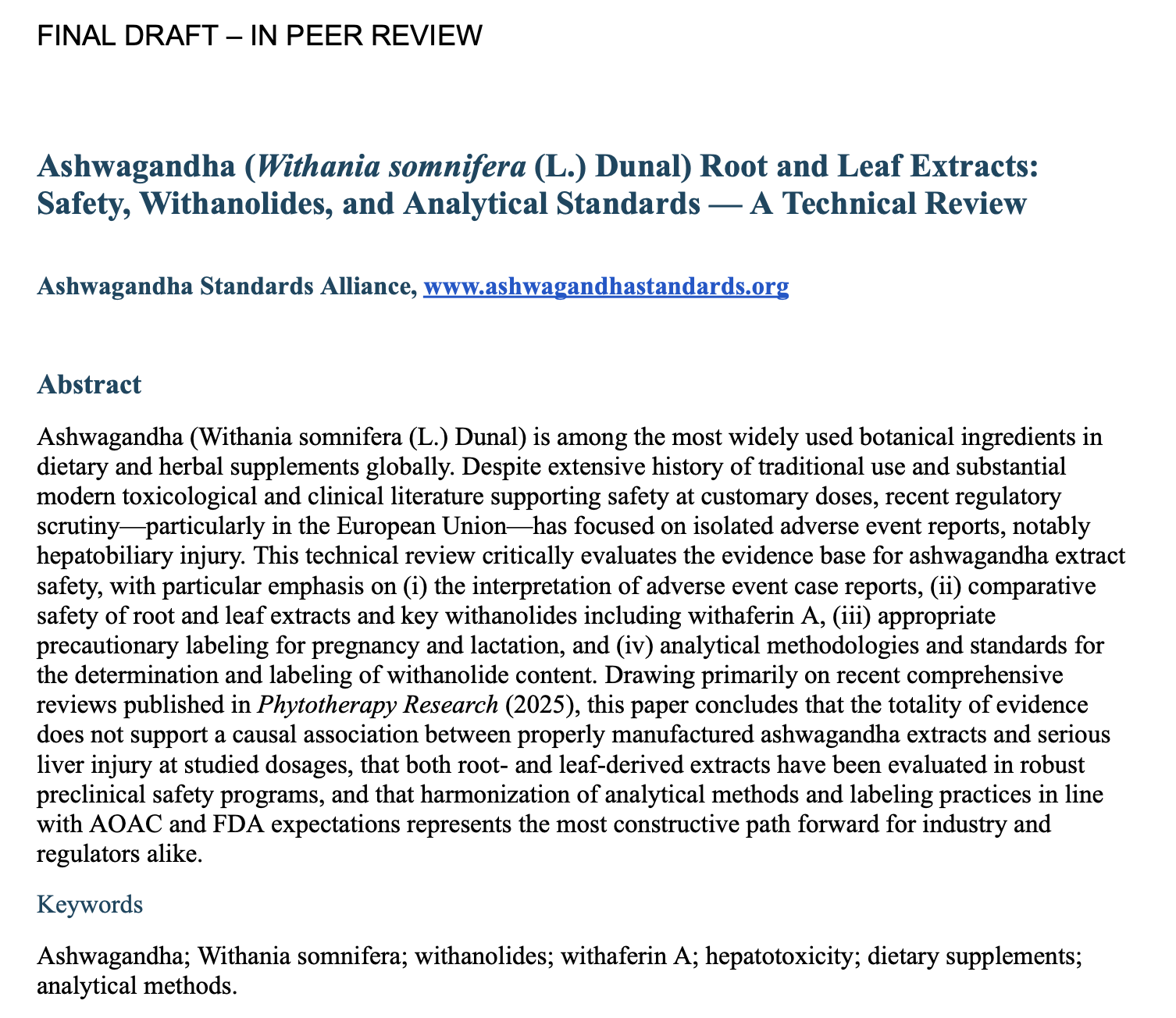
  • Technical Review Paper Drafted on Ashwagandha Safety, Withanolides and Analytical Standards

    Technical Review Paper Drafted on Ashwagandha Safety, Withanolides and Analytical Standards

    The Ashwagandha Standards Alliance has drafted a technical review in internal peer review prior to submission for publication.

    Ashwagandha (Withania somnifera (L.) Dunal) is among the most widely used botanical ingredients in dietary supplements and herbal products globally. Its increasing commercial use has been accompanied by heightened regulatory scrutiny, particularly in relation to isolated reports of hepatobiliary injury and questions regarding the comparative safety of root, leaf, and root–leaf preparations.

    This technical review evaluates the current evidence base for ashwagandha safety, with emphasis on adverse event interpretation, preclinical toxicology, clinical tolerability, plant-part composition, withaferin A, reproductive-risk labeling, and analytical standards for withanolide determination. The review draws substantially on recent comprehensive evaluations published in Phytotherapy Research and places those findings within a quality, regulatory, and analytical framework relevant to manufacturers, ingredient suppliers, finished-product brands, researchers, and regulators. 

    The review concludes that the available evidence does not support a generalized causal association between properly manufactured ashwagandha extracts and serious liver injury at studied dosages. Published case reports of suspected ashwagandha-associated liver injury are important for signal detection, but they are limited by small numbers, incomplete product characterization, lack of quantitative withanolide analysis, absence of botanical-part identification, limited information on extraction methods, and frequent confounding by comorbidities, concomitant medications, pre-existing liver disease, or poorly characterized preparations. 

    In contrast, the broader evidence base includes controlled clinical trials, repeated-dose oral toxicity studies, genotoxicity assessments, reproductive and developmental studies, and long-standing traditional use. Across these evidence categories, a reproducible hepatotoxicity signal has not been demonstrated. Controlled clinical trials have not shown consistent elevations in liver enzymes or serious hepatic adverse events, while preclinical oral toxicity studies commonly report no-observed-adverse-effect levels in the range of 1,000–2,000 mg/kg body weight, corresponding to exposure margins substantially above customary human supplement intakes. 

    The review also addresses the distinction between root, leaf, and root–leaf extracts. Root preparations remain the most extensively studied form of ashwagandha. However, available toxicological and clinical evidence does not demonstrate a distinct safety signal for leaf-containing or root–leaf preparations when such products are authenticated, quality-controlled, and used within studied dose ranges. Current evidence therefore does not support the categorical treatment of leaf material, root–leaf extracts, or elevated withanolide content as inherently unsafe. 

    Withaferin A is considered in detail because of its biological activity and its relatively higher abundance in leaf material. The review emphasizes that in vitro cytotoxicity and pharmacological bioactivity should not be equated with in vivo oral toxicity. Studies of isolated withaferin A and whole ashwagandha extracts have not demonstrated the dose-dependent liver injury, genotoxicity, or systemic toxicity that would be expected if withaferin A were the principal toxicological driver of reported adverse events. Accordingly, withaferin A should be interpreted as one bioactive constituent within a complex botanical matrix, rather than as an intrinsic marker of hazard. 

    The review supports continued conservative precautionary labeling for pregnancy and lactation. This recommendation reflects the absence of adequate controlled human data in these populations and the prudent application of standard dietary supplement risk-management practices. It should not be interpreted as evidence of demonstrated reproductive or developmental toxicity, since the available preclinical data do not establish such a risk. 

    A central conclusion of the review is that ashwagandha safety and quality discussions must be linked to analytical rigor. The term “total withanolides” is not a single uniform measurement. It may vary depending on extraction procedures, chromatographic conditions, reference standards, peak selection, calibration strategy, and the method used to express results. Consequently, numerical withanolide values are not fully interpretable unless the analytical method and reporting basis are clearly disclosed. 

    The review therefore recommends the use of transparent, validated analytical methods consistent with AOAC principles and FDA expectations. Appropriate methods should establish specificity, linearity, accuracy, precision, limits of detection, limits of quantification, and suitability for the relevant botanical matrix. Multi-peak chromatographic fingerprinting should be used as a complementary quality tool to support botanical identity, batch-to-batch consistency, and detection of unintended fractionation or adulteration.

    From a regulatory and quality perspective, the review argues that transparent method validation, accurate labeling, appropriate specifications, and adequate product characterization are preferable to unsupported plant-part prohibitions or single-compound safety thresholds. Narrow compositional restrictions may obscure the central issue: whether the product is authenticated, manufactured under appropriate quality systems, analytically characterized, accurately labeled, and evaluated within a relevant exposure context.

    In summary, the technical review finds that properly manufactured ashwagandha extracts, including root and leaf-containing preparations, have not been shown to present a generalized hepatotoxic risk at studied dosages. The more scientifically defensible path forward is not broad categorical restriction, but improved analytical transparency, stronger quality documentation, validated methods, accurate withanolide labeling, and evidence-based interpretation of adverse event reports.

    For ASA, these findings reinforce the need for public standards that distinguish safety signals from causal evidence, in vitro activity from in vivo toxicity, and marketing claims from validated analytical data. The objective is not to defend every ashwagandha product or every commercial claim. The objective is to support a scientifically credible framework for ashwagandha safety, quality, and labeling.

    To be part of the review and publication of this critical review, consider joining the Alliance as a member.

  • Why Science-Based Standards Matter for Ashwagandha Ingredients

    Why Science-Based Standards Matter for Ashwagandha Ingredients

    Building Trust Through Standards

    Ashwagandha has gained broad attention across the supplement and food industries, but growing interest also brings a greater need for clarity, consistency, and scientific rigor. The Ashwagandha Standards Alliance exists to help advance education, quality, safety, and analytical harmonization so stakeholders can make better-informed decisions about ashwagandha ingredients.

    For manufacturers, researchers, regulators, and consumers alike, standards play an essential role in supporting confidence. Clear expectations around identity, composition, testing, and communication can help reduce confusion and strengthen public trust in products that contain ashwagandha.

    What the Alliance Supports

    • Science-based education about ashwagandha ingredients
    • Greater alignment around quality and safety expectations
    • Analytical harmonization to improve consistency in evaluation
    • Transparency that supports informed decision-making
    • Foundational standards work that benefits the broader marketplace

    By bringing attention to these priorities, the alliance helps create a more credible framework for discussing ashwagandha ingredients. This work is especially important in a category where terminology, testing approaches, and quality expectations may vary across stakeholders.

    Why This Matters Now

    As interest in botanical ingredients continues to expand, the need for dependable standards becomes even more important. A science-based approach can support better product understanding, encourage responsible communication, and help the industry move toward stronger consistency in how ashwagandha ingredients are evaluated and discussed.

    Strong standards help create a stronger foundation for quality, transparency, and public confidence.

    Looking Ahead

    The Ashwagandha Standards Alliance is committed to advancing informed dialogue and practical standards-related work for this important ingredient category. Through communications, educational resources, and foundational efforts, the organization aims to support a more transparent and trustworthy future for ashwagandha ingredients in supplements and foods.

    Follow our Communications updates for insights, alliance news, and ongoing perspectives on quality, safety, and scientific standards.

  • Leaf Ban Hurts Small Farmers the Most

    Leaf Ban Hurts Small Farmers the Most

    May 5, 2026

    Why does agricultural policy tend to ignore the farmers?

    We see the impact now in real-time, in India.

    The recent ashwagandha leaf ban In India is taking food off the table for an untold number of farmers, and for no good reason.  

    An estimated average of 20% of farmer net profits disappeared overnight, based on the whims of bureaucrats.

    A recent farm-level economics paper offers a baseline, with a net return over variable cost of about $356 per acre. Based on a reasonable analysis, the leaf is worth about $72 per acre from existing market demand.

    That may not sound like much to many people, but it is food on the table for rural families in India.

    —-

    A farmer grows a plant. If one part of that plant was previously sold, and is then quickly removed from the legal market, the economics of the farmer suddenly changes for the worse.

    Land preparation, sowing, irrigation, harvesting, processing and transport costs don’t just disappear when the leaf market disappears.

    The farmer is simply paid substantially less for their crop.

    And if they don’t profit from their crop, they will decide not to grow it.

    The Ministry of Ayush and Fssai ,Food License Registration India actions are considered especially devastating for rain-fed farmers in the arid regions where ashwagandha is grown.

    The regions where ashwagandha is cultivated — like Andhra Pradesh and Gujarat — are characterized by poverty and low agricultural potential.

    Not much else can be cultivated in these regions without the money for irrigation and fertilizer that ashwagandha farmers often don’t have.

    And as reported to the Ashwagandha Standards Alliance, some root-only buyers in India are prohibiting their farmers from selling leaf — forcing them to plow their money back into the soil.

    20% of net profit isn’t a rounding error for these farmers. That leaf is literally the difference between survival and starvation for their family.  

    Stay tuned for more detailed economic impact analyses related to the leaf ban on ashwagandha farmers.

  • Technical Rebuttal to Recent Claims Regarding Ashwagandha Leaf

    Technical Rebuttal to Recent Claims Regarding Ashwagandha Leaf

    Technical Rebuttal to Recent Claims Regarding Ashwagandha Leaf, “Adulteration,” Method Validity, and the April 2026 Indian Regulatory Actions is a technical position report addressing recent regulatory and media claims that equate Withania somnifera leaf use with adulteration. The report argues that this framing is scientifically overbroad and technically imprecise. It distinguishes between undisclosed plant-part substitution, disclosed use of leaf or root-and-leaf material, and unsupported potency claims based on inadequately disclosed or non-fit-for-purpose analytical methods. 

    The central thesis is that “adulteration” should not be used as a categorical descriptor for all ashwagandha products containing leaf material. If a product is represented as ashwagandha root or root extract but contains undeclared leaf or aerial parts, that may constitute adulteration, misbranding, or failure to meet specification, depending on the relevant jurisdiction and claim. However, if a product is accurately described as containing leaf, aerial parts, or root-and-leaf material, the appropriate evaluation is not categorical condemnation but a technical assessment of identity, composition, specifications, safety data, exposure, labeling, and regulatory category. 

    The report also identifies a second and independent quality concern: the validity of “withanolides” potency claims. It argues that a generic percentage claim, such as “5% withanolides,” is not scientifically meaningful unless the analytical method is disclosed or otherwise sufficiently characterized, the compounds measured are clearly identified, the method is fit for the matrix tested, and the result is reproducible. A certificate of analysis reporting a potency value does not itself establish that the claim is valid. The analytical method must support the specific claim being made. 

    A major technical contribution of the report is its separation of three issues often conflated in public discussion: first, undisclosed substitution of leaf for root; second, disclosed and characterized use of leaf, aerial parts, or root-and-leaf material; and third, potency claims made without valid analytical support. The report emphasizes that these are distinct compliance and scientific questions. Undisclosed substitution concerns identity and labeling. Disclosed plant-part use concerns safety, exposure, specification, and jurisdictional status. Unsupported potency claims concern method validity, GMP compliance, label substantiation, and reproducibility. 

    The report critiques the April 2026 Indian regulatory actions by the Ministry of Ayush and FSSAI as establishing or reiterating a root-only position for certain Indian regulatory categories, including Ayush products and Indian food products. It argues that these actions should not be automatically interpreted as a global scientific finding that leaf-containing ashwagandha products are unsafe, adulterated, or unlawful in other jurisdictions. The report stresses that Indian regulatory decisions may affect supply and compliance in India and related markets, but should not be generalized beyond their legal and evidentiary scope without independent scientific review. 

    The report gives particular attention to the role of analytical method validity in ashwagandha quality control. It notes that different methods may measure different compounds or compound classes, including selected withanolide aglycones, withanolide glycosides, withaferin A, calculated equivalents, hydrolyzed totals, or chromatographic fingerprints. Therefore, “total withanolides” is method-dependent and may be incomplete or misleading unless the analytes, method, matrix, validation status, and intended analytical purpose are disclosed. 

    The document proposes a technical framework for ashwagandha quality assessment. This framework includes botanical identity, plant-part confirmation, marker-compound quantification, chromatographic fingerprinting, detection of undeclared substitution, fit-for-purpose potency testing, safety-relevant constituent limits, batch-to-batch consistency, finished-product verification, and label-claim substantiation. These elements are presented as necessary to distinguish legitimate quality concerns from commercially convenient or scientifically unsupported narratives. 

    The report also challenges the assumption that tradition alone determines safety or legality. It acknowledges the long historical use of ashwagandha root in Ayurveda but argues that modern commercial extracts must be evaluated by composition, dose, exposure, manufacturing process, marker profile, contaminant profile, analytical method validity, and clinical or toxicological data. Conversely, it argues that a less traditional plant part is not automatically unsafe merely because its historical use differs from root. Safety must be evaluated by the actual article of commerce and its intended conditions of use. 

    The report’s discussion of public and trade-media framing is also significant. It argues that sponsored or commercially interested narratives have blurred the distinction between regulatory action, scientific consensus, promotional claims, and independent technical analysis. The document does not reject regulation or enforcement. Rather, it calls for transparency regarding the evidence used by regulators, expert-committee composition, conflicts of interest, stakeholder submissions, analytical methods cited in public claims, and the rationale for treating leaf use as a categorical prohibition rather than a composition- and exposure-specific safety question. 

    The report concludes that ashwagandha quality standards should not be reduced to a simple “root good, leaf bad” framework. A scientifically defensible approach should evaluate whether the species is correctly identified, the plant part is truthfully labeled, the extract is fully characterized, potency claims are method-valid, safety data match the article of commerce, and claims are substantiated by relevant evidence. Under this approach, undisclosed substitution and unsupported potency claims are legitimate compliance concerns, while disclosed root-and-leaf use requires product-specific evaluation rather than categorical classification as adulteration.

  • Review of Ashwagandha: An umbrella review of the efficacy evidence

    Review of Ashwagandha: An umbrella review of the efficacy evidence

    Ashwagandha: An Umbrella Review of the Efficacy Evidence by Brendler and Rattray (preprint, 2026) provides a comprehensive evaluation of the human clinical evidence for Withania somnifera across the principal efficacy domains associated with its traditional and contemporary use.

    The authors identified 134 clinical trial reports published over approximately 45 years, of which 133 were included in the assessment. Rather than limiting the review to existing meta-analyses or systematic reviews, the authors attempted to map the available clinical trial literature directly and organize it by major outcome categories. These included stress, anxiety, mood, sleep, energy, endurance, musculoskeletal outcomes, reproductive and sexual health, cognition, safety, tolerability, pharmacokinetics, metabolic endpoints, inflammatory conditions, pediatric outcomes, and adjunctive oncology-related research. 

    The review is framed against the background of increasing regulatory scrutiny of ashwagandha, particularly in the European Union, where concerns regarding safety in food supplements have contributed to discussion of a possible Article 8 procedure under Regulation (EC) No. 1925/2006. The authors therefore examine not only whether clinical trials report efficacy, but also how the breadth and quality of the human evidence base should be interpreted in relation to contemporary risk assessment. 

    The most extensively studied clinical domains are stress, anxiety, mood, sleep, cognition, physical performance, and reproductive health. In stress and anxiety studies, multiple randomized, double-blind, placebo-controlled trials reported improvements in validated psychometric measures, including perceived stress, anxiety scales, mood indices, and quality-of-life measures. Several studies also reported reductions in cortisol, supporting the interpretation that ashwagandha may exert effects through modulation of stress-response physiology. Products studied in this domain included KSM-66, Shoden, Sensoril/Essentra, Shagandha, Prolanza/AshwaSR, Zenroot, PE-series extracts, and root powder preparations. 

    Evidence for effects on energy, endurance, and musculoskeletal outcomes was also substantial. Trials reported improvements in measures such as VO₂ max, resistance-training adaptations, muscle strength, recovery scores, fatigue indices, walking distance, and quality-of-life outcomes. However, the magnitude and consistency of these effects varied by product, study population, training context, trial duration, and endpoint selection. Some trials reported statistically significant improvements, while others found no meaningful effect beyond training or placebo-associated changes. This pattern indicates a potentially meaningful but product- and context-dependent evidence base rather than a uniform class effect. 

    The review also summarizes a considerable number of trials involving reproductive and sexual health outcomes. In men, studies evaluated semen parameters, sperm concentration and motility, testosterone, luteinizing hormone, sexual desire, erectile function, and fertility-related endpoints.

    Several studies reported improvements in sperm parameters and increases in testosterone or luteinizing hormone. In women, studies evaluated sexual function, sexual distress, menopausal symptoms, estradiol, follicle-stimulating hormone, luteinizing hormone, and quality-of-life measures. Some trials reported improvements in female sexual function and menopausal symptom scores, and several reported changes in reproductive hormones. These findings suggest that ashwagandha may have measurable effects on reproductive or endocrine physiology in some populations, although interpretation requires attention to baseline health status, dose, extract type, and study design. 

    The clinical evidence base is unevenly distributed across product types. Root powder preparations represent a large portion of the evidence base, particularly in reproductive health, endurance, and traditional-use-related endpoints.

    A notable feature of the review is that the clinical evidence is not confined to root-only preparations.

    While root extracts and root powders constitute a large share of the trial literature, root-and-leaf preparations are also represented. Sensoril and Shoden, for example, appears across multiple clinical domains, including stress, mood, cognition, hemodynamic stress response, menopause-related outcomes, osteoarthritis, and joint pain.

    The presence of root-and-leaf preparations in human clinical trials is relevant to plant-part safety discussions because it shows that leaf-containing preparations have been studied clinically, rather than existing only as untested exposures.

    Sensoril/Essentra and Shoden are examples of preparations containing both root and leaf, both studied for stress, mood, cognition, menopause, joint pain, and related outcomes. Other extracts and preparations contribute smaller but sometimes focused datasets. This distribution is important because clinical findings for one extract cannot automatically be generalized to all ashwagandha preparations, unless the preparations are chemically and pharmacologically comparable. 

    The safety, tolerability, and pharmacokinetic data summarized in the review include dedicated studies of root extracts and other standardized preparations. Pharmacokinetic and tolerability studies involving Shoden, Prolanza, Zenroot, KSM-66, LongeFera, Witholytin/AgeVel, and other preparations provided evidence of systemic withanolide exposure from root and leaf, and generally favorable tolerability in the studied populations. 

    For more information on clinical trials on ashwagandha, contact us.