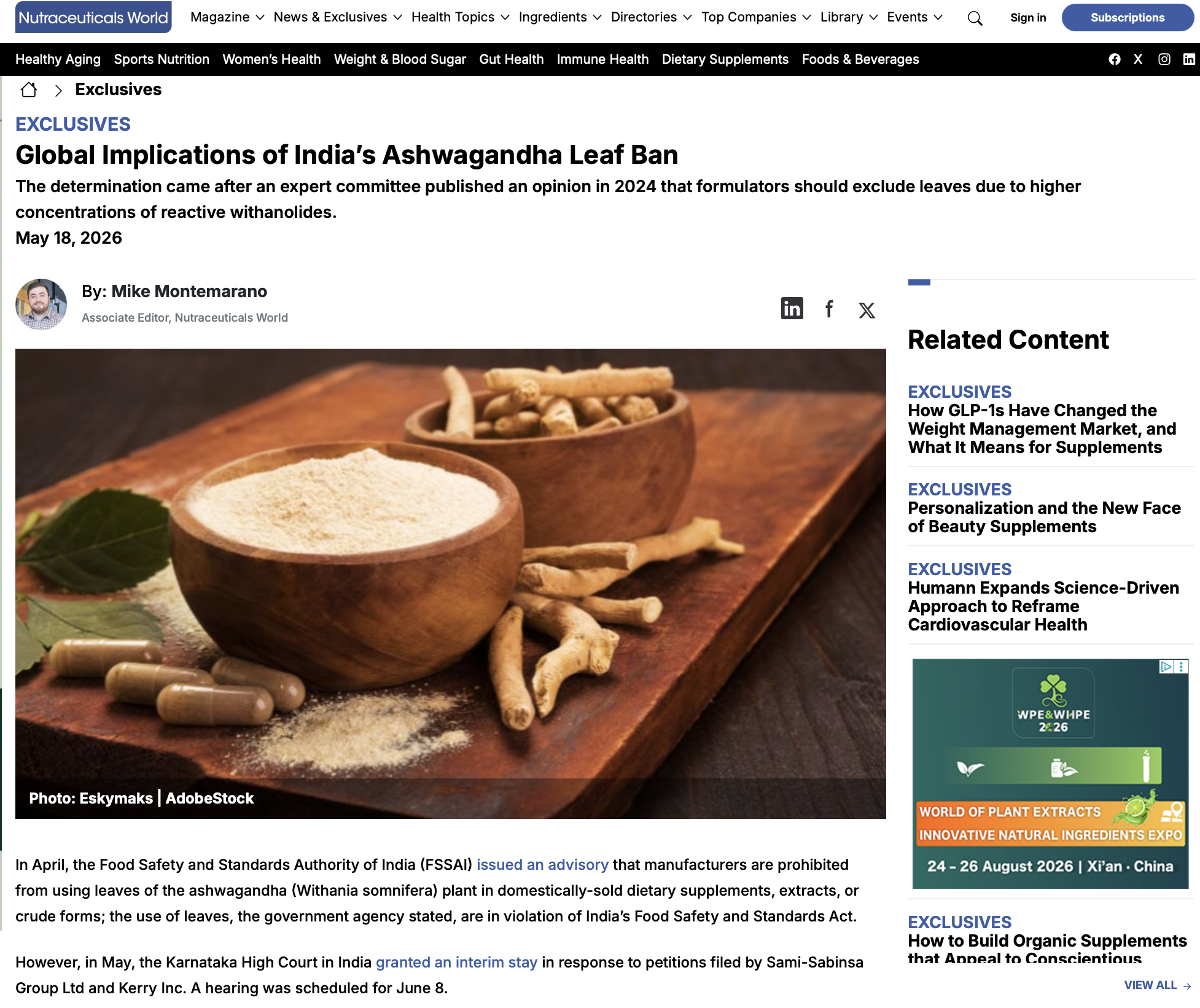
I appreciate Monday’s ashwagandha article in Nutraceuticals World for the wide range of opinions expressed.
This article correctly identifies one central scientific issue: that root, leaf, and root+leaf materials may be chemically similar, but are not identical.
It also points out the variation among legitimate products, and that generic total-withanolide claims are no longer enough.
And the article provided a sketch of the underlying story that’s still being written…
——
That story is partly about the fact that a plant-part ban doesn’t fix the current problems we face. Of unverifiable specifications, non-replicable test methods, and mislabeling of root-only products.
That story is about the path already taken that has industry facing the potential for regulatory bans of ashwagandha as a whole — much less the possibility of a root-only standard.
As Shaheen Majeed explained, a root-only standard would have enormous consequences. It would benefit some responsible suppliers and brands, while harming others. Most of all, it would affect the entire value chain — from farmer to consumer, and could reshape the global category.
That kind of decision requires transparent processes, a focus on what is or isn’t true — and most of all, conflict disclosure of those leading the ‘root-only standard’ argument.
Although the trade media has done a fairly good job on reporting on the topic, one key distinction is being missed, which is undeclared adulteration versus declared plant part from legitimate and science-backed products.
That is, this is not just about the plant part.
If a product is labeled as root-only water extract, then it should contain nothing but root water extract — no residual solvents or undeclared fillers detected. If not, that’s a quality and safety problem.
If a product is labeled as root and contains undeclared leaf, then yes, that’s a quality problem.
If a product doesn’t declare plant part, but is labeled or assumed to be root — that’s also a problem.
But if a product is declared root+leaf with specifications, toxicology, clinical studies, and defined amounts of the specific marker compounds all aligned — that’s GMP and it’s safe according to the science.
—–
The industry should not let plant part become a cover for an oversimplified narrative that hides underlying issues.
And this narrative should not be a default shortcut to “all use of leaf is adulteration”. Those two are not synonymous, and plus they are untruthful and hurtful.
Because that narrative also means “root-only companies get to define the market.”
Better standardization, labeling and testing is needed.
But the nuance needs to be presented, and the policy decisions should be transparent.
The outcomes should be proportional to risk, arising from rigorous, transparent and consensus-based policy.
That’s how truth wins out in the end.
Source: LinkedIn Post on May 21, 2026 by Blake Ebersole, Alliance Founding Member
Nutraceuticals World Article: https://www.nutraceuticalsworld.com/exclusives/global-implications-of-indias-ashwagandha-leaf-ban/