
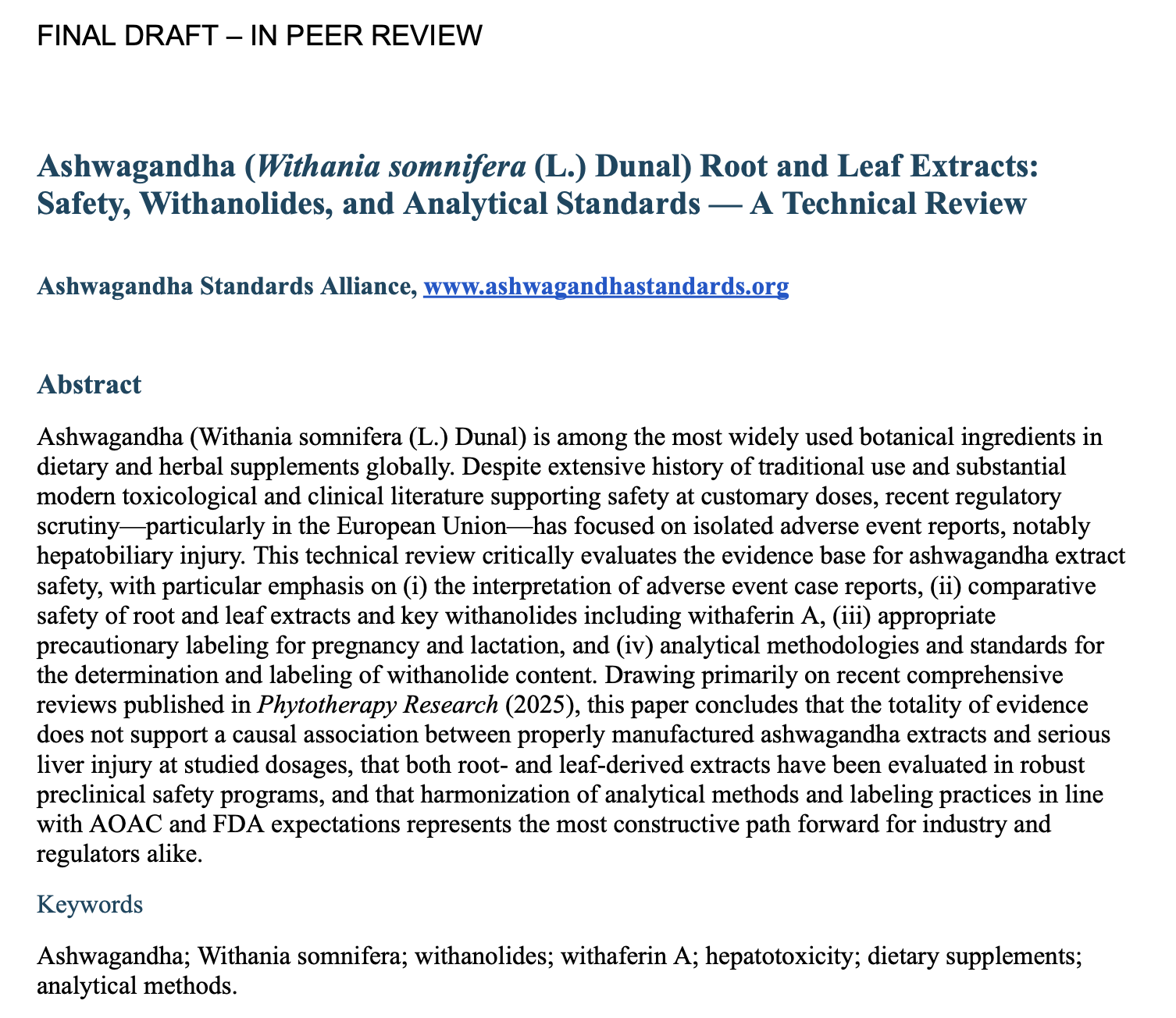
The Ashwagandha Standards Alliance has drafted a technical review in internal peer review prior to submission for publication.
Ashwagandha (Withania somnifera (L.) Dunal) is among the most widely used botanical ingredients in dietary supplements and herbal products globally. Its increasing commercial use has been accompanied by heightened regulatory scrutiny, particularly in relation to isolated reports of hepatobiliary injury and questions regarding the comparative safety of root, leaf, and root–leaf preparations.
This technical review evaluates the current evidence base for ashwagandha safety, with emphasis on adverse event interpretation, preclinical toxicology, clinical tolerability, plant-part composition, withaferin A, reproductive-risk labeling, and analytical standards for withanolide determination. The review draws substantially on recent comprehensive evaluations published in Phytotherapy Research and places those findings within a quality, regulatory, and analytical framework relevant to manufacturers, ingredient suppliers, finished-product brands, researchers, and regulators.
The review concludes that the available evidence does not support a generalized causal association between properly manufactured ashwagandha extracts and serious liver injury at studied dosages. Published case reports of suspected ashwagandha-associated liver injury are important for signal detection, but they are limited by small numbers, incomplete product characterization, lack of quantitative withanolide analysis, absence of botanical-part identification, limited information on extraction methods, and frequent confounding by comorbidities, concomitant medications, pre-existing liver disease, or poorly characterized preparations.
In contrast, the broader evidence base includes controlled clinical trials, repeated-dose oral toxicity studies, genotoxicity assessments, reproductive and developmental studies, and long-standing traditional use. Across these evidence categories, a reproducible hepatotoxicity signal has not been demonstrated. Controlled clinical trials have not shown consistent elevations in liver enzymes or serious hepatic adverse events, while preclinical oral toxicity studies commonly report no-observed-adverse-effect levels in the range of 1,000–2,000 mg/kg body weight, corresponding to exposure margins substantially above customary human supplement intakes.
The review also addresses the distinction between root, leaf, and root–leaf extracts. Root preparations remain the most extensively studied form of ashwagandha. However, available toxicological and clinical evidence does not demonstrate a distinct safety signal for leaf-containing or root–leaf preparations when such products are authenticated, quality-controlled, and used within studied dose ranges. Current evidence therefore does not support the categorical treatment of leaf material, root–leaf extracts, or elevated withanolide content as inherently unsafe.
Withaferin A is considered in detail because of its biological activity and its relatively higher abundance in leaf material. The review emphasizes that in vitro cytotoxicity and pharmacological bioactivity should not be equated with in vivo oral toxicity. Studies of isolated withaferin A and whole ashwagandha extracts have not demonstrated the dose-dependent liver injury, genotoxicity, or systemic toxicity that would be expected if withaferin A were the principal toxicological driver of reported adverse events. Accordingly, withaferin A should be interpreted as one bioactive constituent within a complex botanical matrix, rather than as an intrinsic marker of hazard.
The review supports continued conservative precautionary labeling for pregnancy and lactation. This recommendation reflects the absence of adequate controlled human data in these populations and the prudent application of standard dietary supplement risk-management practices. It should not be interpreted as evidence of demonstrated reproductive or developmental toxicity, since the available preclinical data do not establish such a risk.
A central conclusion of the review is that ashwagandha safety and quality discussions must be linked to analytical rigor. The term “total withanolides” is not a single uniform measurement. It may vary depending on extraction procedures, chromatographic conditions, reference standards, peak selection, calibration strategy, and the method used to express results. Consequently, numerical withanolide values are not fully interpretable unless the analytical method and reporting basis are clearly disclosed.
The review therefore recommends the use of transparent, validated analytical methods consistent with AOAC principles and FDA expectations. Appropriate methods should establish specificity, linearity, accuracy, precision, limits of detection, limits of quantification, and suitability for the relevant botanical matrix. Multi-peak chromatographic fingerprinting should be used as a complementary quality tool to support botanical identity, batch-to-batch consistency, and detection of unintended fractionation or adulteration.
From a regulatory and quality perspective, the review argues that transparent method validation, accurate labeling, appropriate specifications, and adequate product characterization are preferable to unsupported plant-part prohibitions or single-compound safety thresholds. Narrow compositional restrictions may obscure the central issue: whether the product is authenticated, manufactured under appropriate quality systems, analytically characterized, accurately labeled, and evaluated within a relevant exposure context.
In summary, the technical review finds that properly manufactured ashwagandha extracts, including root and leaf-containing preparations, have not been shown to present a generalized hepatotoxic risk at studied dosages. The more scientifically defensible path forward is not broad categorical restriction, but improved analytical transparency, stronger quality documentation, validated methods, accurate withanolide labeling, and evidence-based interpretation of adverse event reports.
For ASA, these findings reinforce the need for public standards that distinguish safety signals from causal evidence, in vitro activity from in vivo toxicity, and marketing claims from validated analytical data. The objective is not to defend every ashwagandha product or every commercial claim. The objective is to support a scientifically credible framework for ashwagandha safety, quality, and labeling.
To be part of the review and publication of this critical review, consider joining the Alliance as a member.