
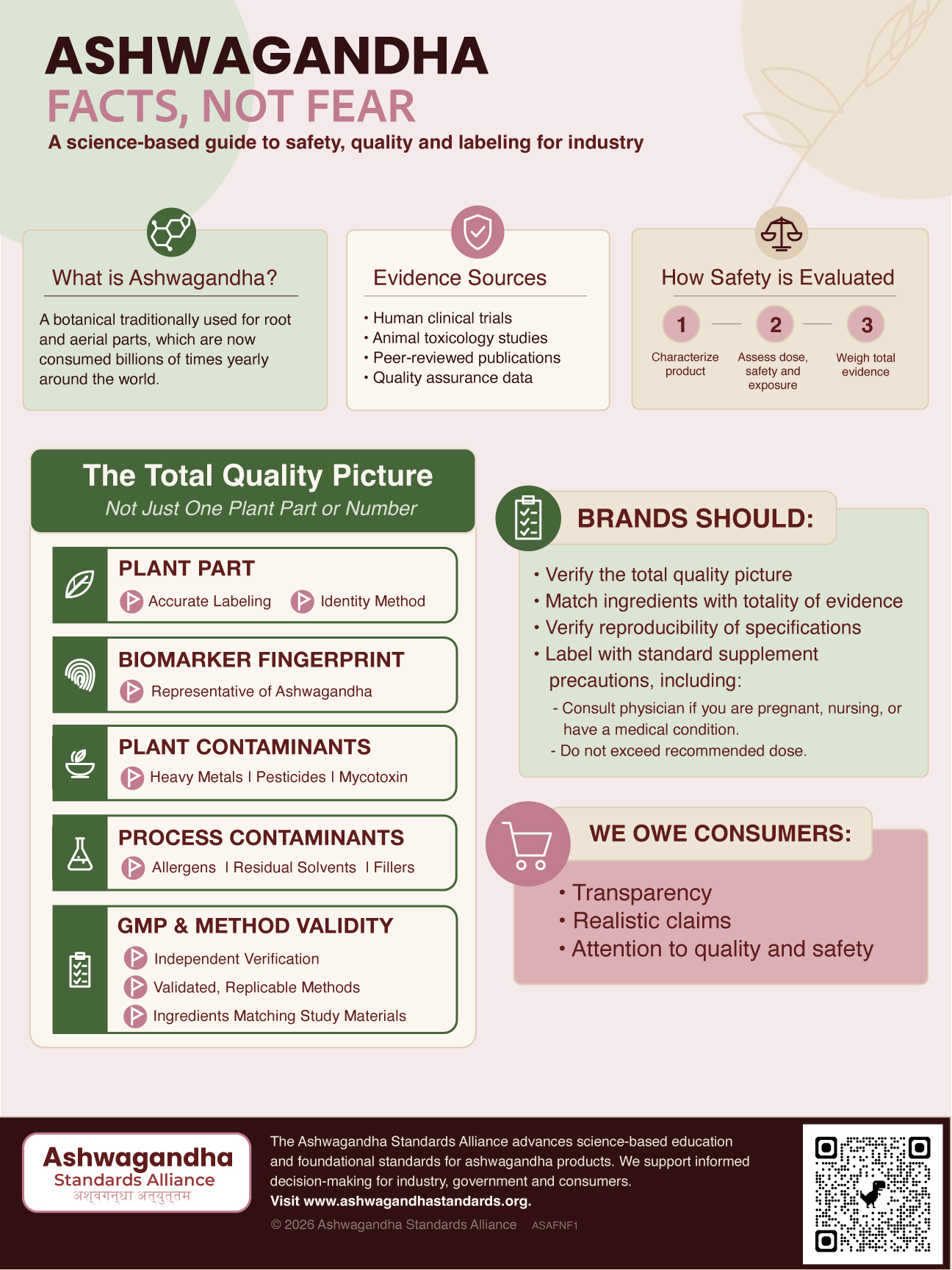
A Science-Based Guide to Safety, Quality and Labeling for Industry
The Ashwagandha Standards Alliance has released a new educational infographic, Ashwagandha Facts, Not Fear, to help brands, regulators, practitioners and consumers better understand how ashwagandha products should be evaluated.
Ashwagandha is one of the most widely used botanicals in the world. It is also increasingly the subject of simplified narratives that do not reflect the full evidence base or the complexity of botanical quality.
A quality ashwagandha product cannot be defined by a single plant part, a single constituent or a single number on a specification sheet.
It must be evaluated as a complete product.
Safety Requires the Totality of Evidence
Safety evaluation begins by identifying what product is actually being used: the plant part, extract type, dose, biomarker fingerprint, manufacturing process and intended population.
From there, safety assessment should consider:
- Human clinical trials
- Animal toxicology studies
- Peer-reviewed publications
- Quality assurance data
- Dose and exposure
- Product-specific composition
This is how responsible evaluation works: characterize the product, assess the dose and exposure, and weigh the totality of evidence.
Not by fear, marketing or treating all ashwagandha ingredients as interchangeable.
Quality Is More Than Plant Part
Plant part matters. But plant part alone does not establish quality, safety or clinical relevance.
A complete quality assessment should also address:
- Biomarker fingerprint: Is the product chemically representative of the ashwagandha material it claims to contain? Which withanolides are identified on the HPLC chromatogram representing “total withanolides”?
- Plant contaminants: Has the product been appropriately assessed for heavy metals, pesticides and mycotoxins?
- Process contaminants: Have risks from allergens, residual solvents, fillers or other manufacturing-related issues been evaluated? Are they being truthfully labeled on ingredients and finished products?
- Method validity: Are analytical methods validated, replicable and fit for purpose?
- Independent verification: Can product specifications be reproduced and confirmed?
- Evidence matching: Does the marketed ingredient actually match the material used in supporting studies?
The answers to these questions determine whether brands can stand behind their products — and whether consumers can trust what is on the label.
What Brands Should Do
Brands selling ashwagandha products have a responsibility to move beyond simplified narratives and verify the total quality picture.
That means they should:
- Verify the identity, composition and quality of their ingredients.
- Match ingredients to the totality of relevant evidence.
- Confirm that specifications are reproducible using valid analytical methods.
- Use accurate labeling.
- Provide standard supplement precautions, including guidance for individuals who are pregnant, nursing or managing medical conditions.
- Ensure consumers are instructed not to exceed the recommended dose.
What Consumers Deserve
Consumers deserve more than reassuring slogans or alarming headlines.
They deserve:
- Transparency
- Realistic claims
- Meaningful attention to quality and safety
- Products supported by appropriate evidence
- Labels that accurately describe what is being sold
The goal is not to dismiss safety questions. The goal is to evaluate them correctly.
Building Better Standards for Ashwagandha
The Ashwagandha Standards Alliance advances science-based education and foundational standards for ashwagandha products. We support informed decision-making by industry, government and consumers through transparent evaluation of quality, safety, methods and labeling.
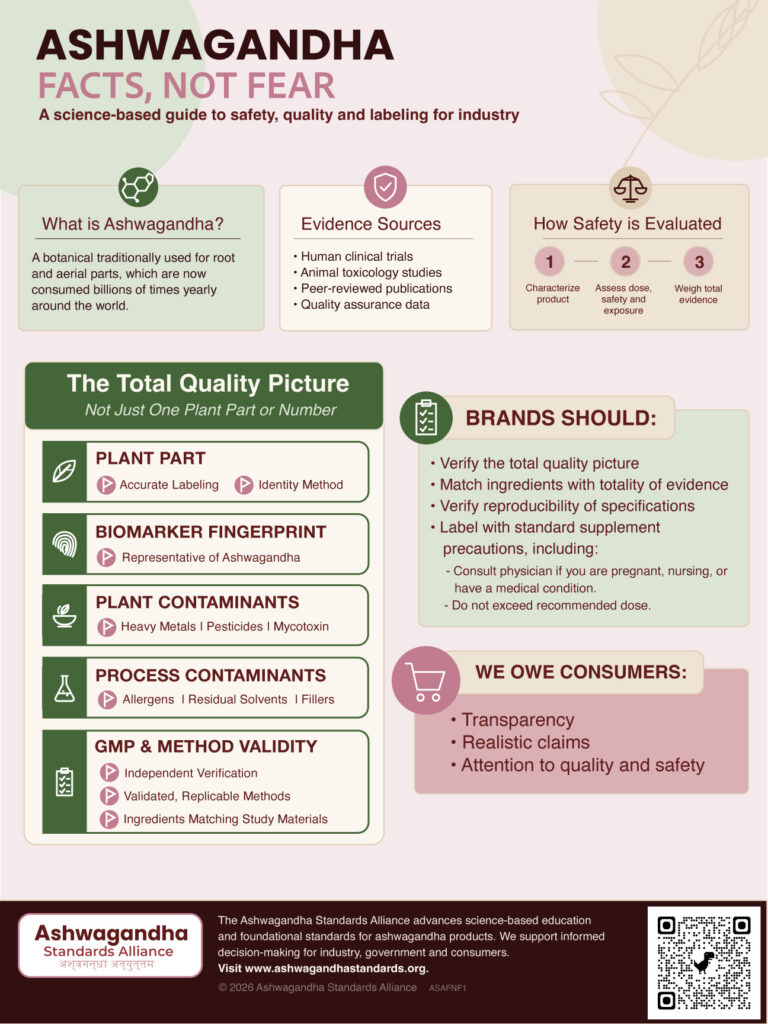
Download and share the infographic: Ashwagandha Facts, Not Fear — A Science-Based Guide to Safety, Quality and Labeling for Industry.
Learn more about the Ashwagandha Standards Alliance at www.ashwagandhastandards.org.